Software Architecture
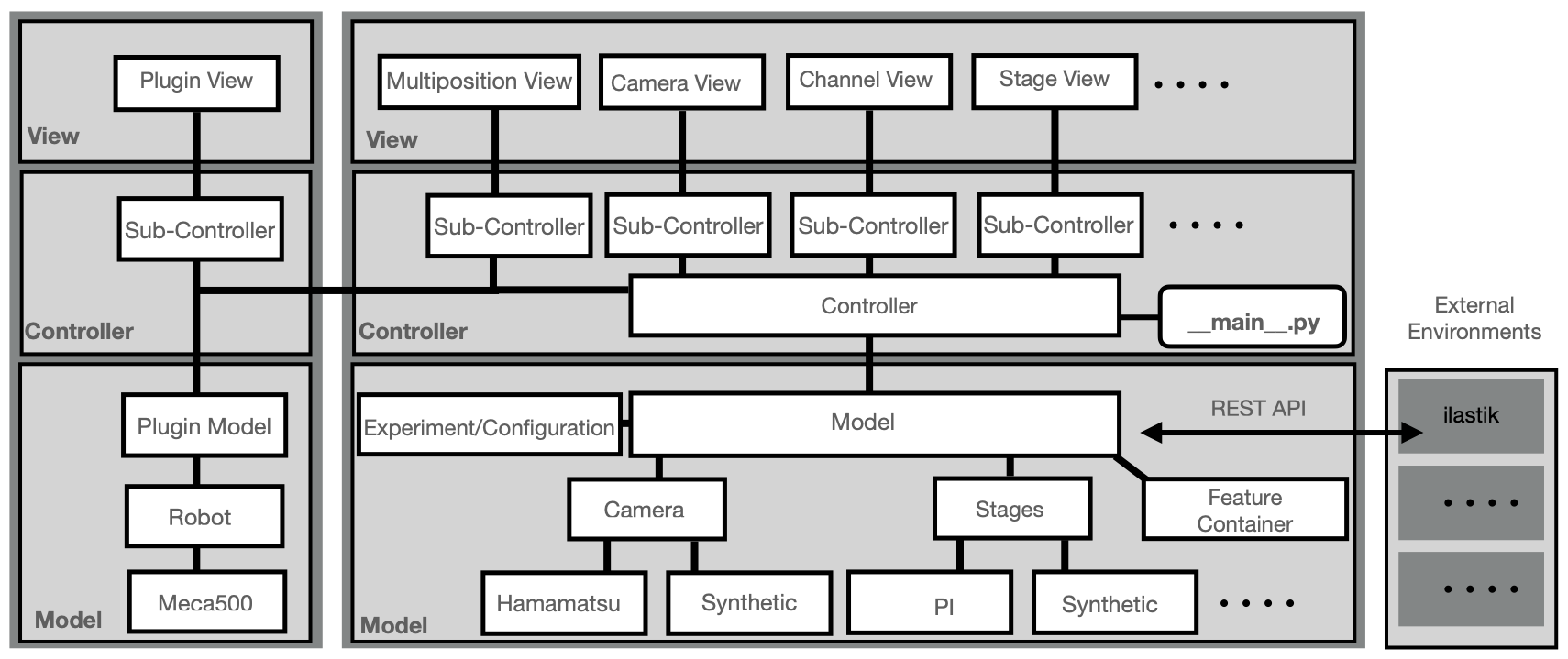
Model-View-Controller (MVC)
The architecture of navigate follows the Model-View-Controller (MVC) pattern. In this structure:
Model: Runs in its own subprocess and is responsible for hardware communication and image handling. Communication with the controller is managed through event queues.
View: Displays the graphical user interface (GUI) and communicates with the controller. Each GUI area (for example, camera display and autofocus) is managed by a dedicated sub-controller.
Controller: Coordinates data flow between model and view. It relays user input to the model and routes model output (images, status, metrics) back to the view.
Extensibility
To maximize extensibility, navigate includes:
REST API layer: A REST interface allows navigate to exchange data with external tools through an HTTP server, without forcing intermediate file saves.
Plugin layer: Plugins provide a supported path to add new devices, features, and workflows.
Data Acquisition and Processing
navigate employs a feature container for running acquisition routines, characterized by:
Reconfigurable workflows: Custom acquisition workflows can include computer-vision feedback.
Threading and parallelization: Large data objects and acquisition tasks are handled with concurrency where needed.
Tree data structure: Acquisition, imaging, and analysis steps are represented as a reconfigurable tree of operations.
Image analysis routines: Custom analysis can run at runtime on in-memory NumPy arrays.
Feature Lists
Feature lists are highly versatile, capable of:
Sequential execution: Acquisition routes can run in a predefined order.
Logic integration: Conditional branches and loop structures can be embedded in the workflow.
Non-imaging processes: Hardware operations such as solvent exchange can be integrated with imaging tasks.
Microscope Objects
navigate supports multiple microscope objects defined in configuration.yaml. Each microscope object:
Independent or shared hardware: A microscope can own its hardware or share components with other microscope definitions.
Multi-modal imaging: Different imaging modalities can coexist in one system.
Custom acquisition routines: Each microscope can map to different acquisition routines and switch at runtime.
This architecture allows for highly adaptable and reconfigurable imaging systems tailored to complex experimental needs.
Developer Deep Dive
For implementation-level details that are useful when editing the codebase, see Developer Architecture Concepts.